Street Fighter III: 3rd Strike

Introduction

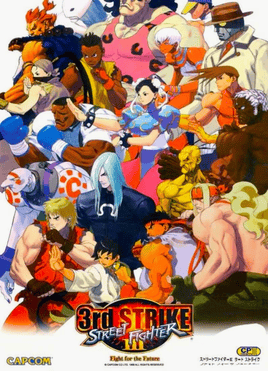
Street Fighter III: 3rd Strike – Fight for the Future was developed and published by Capcom on CPS-3 arcade hardware, released in 1999 as the third and final revision of Street Fighter III, following the original New Generation and its update, 2nd Impact. The game refined the series’ Parry system, a precisely timed defensive technique that let skilled players deflect incoming attacks and immediately counter, into one of the most technically demanding and celebrated mechanics in fighting game history, rewarding split-second reads over simple blocking. Its roster expanded with new characters including Makoto, Q, Remy, Twelve, and the returning fan-favorite Chun-Li, alongside a redesigned cast of largely new fighters that had first appeared in New Generation rather than the classic Street Fighter II lineup. Though it sold modestly on release compared to Capcom’s earlier hits, 3rd Strike’s deep, precision-focused combat system earned it a devoted competitive following that only grew over time, and it remains widely regarded by fighting game communities as one of the greatest and most technically refined fighters ever made.

Street Fighter III: 3rd Strike

How to Play Street Fighter III: 3rd Strike Online

Press Start Game above to load the arcade emulator, insert a coin with Select and press Start. After choosing your fighter you also pick one of three Super Arts, which decides the super move you can use that match. 3rd Strike uses the classic six-button layout. A gamepad or arcade stick is best for parries and special moves, but you can play on the keyboard and remap keys in Control Settings in the emulator menu.

Controls and Core Techniques

Input Action
Joystick Move, jump, crouch; hold back to block
Light / Medium / Heavy Punch and Kick Normal attacks
Tap forward as an attack hits Parry a high or mid attack with no damage
Tap down as an attack hits Parry a low attack
Special move with two buttons of the same type EX special move (uses part of the Super Art gauge)
Super motion + button Super Art

Tips

  • Learn to parry. Parrying is the heart of 3rd Strike. It takes no damage, even from special moves, and leaves your opponent open. Practise against single, predictable attacks first.
  • Choose the right Super Art. Short gauges let you use a super more often; long gauges give one big, damaging move.
  • Use EX moves for safer or stronger versions of your specials when you have spare meter.
  • Do not jump carelessly. Most characters have strong anti-air attacks, and jumping is easy to punish.
  • Start with Ryu, Ken or Chun-Li, whose moves are easy to learn, before trying technical characters like Q or Twelve.

Characters

The roster has 20 fighters, including returning Ryu, Ken, Chun-Li and Akuma along with Alex, Dudley, Elena, Ibuki, Makoto, Necro, Oro, Q, Remy, Sean, Twelve, Urien, Yang, Yun and Hugo. The final boss is Gill, leader of the Illuminati.

History and Legacy

Capcom released 3rd Strike in arcades in 1999 as the last update of Street Fighter III. It is famous for one of the most replayed moments in competitive gaming: at Evo 2004, Daigo Umehara parried every hit of a Chun-Li super and turned the round around, a clip known as “Evo Moment 37”. For the earlier Street Fighter style, try Street Fighter Alpha 2 or Street Fighter II Turbo.
Similar Posts

  • World Heroes 2

    Introduction World Heroes 2 was developed and published by ADK, with assistance from SNK, for the Neo Geo MVS arcade system, released in April 1993 as the sequel to 1992’s World Heroes and notably the first release to carry the ADK name after the studio rebranded from its earlier identity as Alpha Denshi. The game…

  • Metal Slug

    Introduction Metal Slug was developed by Nazca Corporation, a studio staffed largely by former Irem developers behind games like In the Hunt and GunForce II, and released by SNK for the Neo Geo MVS arcade system in April 1996, shortly before Nazca merged into SNK outright. The game underwent a major shift mid-development: it was…

  • The King of Fighters ’99

    Introduction SNK released The King of Fighters ’99 for the Neo Geo in 1999, opening a new chapter of the series known as the NESTS saga. The story introduces K’, a mysterious fighter connected to a shadowy organisation, who becomes the new lead character. The biggest change is the team structure: teams now have four…

  • Strikers 1945

    Introduction Strikers 1945 was developed and published by Psikyo, released in arcades in 1995 as the Japanese shoot ’em up studio’s tribute to Capcom’s earlier 19XX series, borrowing that franchise’s WWII fighter-plane theme while building an entirely original game around it. Players choose from a roster of real and fictional World War II-era aircraft, each…

  • Alien vs. Predator

    Introduction Alien vs. Predator was developed and published by Capcom on its CPS-2 arcade hardware, licensed from Twentieth Century Fox and built by a team including designers Tetsuya Iijima, Toshihiko Uda, and Jun Matsumura with a score by Hideki Okugawa, releasing in Japanese arcades in May 1994 before reaching other regions shortly after. Capcom leaned…

  • The King of Fighters ’98

    Introduction The King of Fighters ’98, known in Japan as Dream Match Never Ends, was developed and published by SNK for the Neo Geo arcade and home systems in 1998 as the fifth entry in the King of Fighters series. Rather than pushing the ongoing story forward, SNK explicitly marketed it as a special ‘dream…