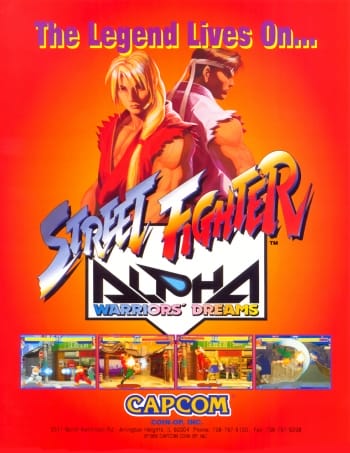
Street Fighter Alpha: Warriors’ Dreams
Introduction
Street Fighter Alpha: Warriors’ Dreams was developed and published by Capcom, released in arcades in 1995 as the first entry in the Street Fighter Alpha sub-series, set as a prequel taking place between the original Street Fighter and Street Fighter II. The game introduced a noticeably different visual style from its predecessors, using a more exaggerated, expressive art direction that would come to define the Alpha series, alongside a new Ism selection system that let players choose between different rulesets before a match, adjusting super meter behavior, air-blocking availability, and overall pacing. Its cast blended returning favorites like Ryu, Ken, and Chun-Li with characters pulled from Final Fight, including Cody, Guy, and Sodom, formally linking the two Capcom franchises within the fighting game canon for the first time. The game’s new Alpha Counter and chainable Custom Combo mechanics added fresh tactical options on top of Street Fighter II’s established special-move foundation, giving experienced players new tools while keeping the core fighting system approachable. Warriors’ Dreams launched a well-regarded sub-series that would continue through two numbered sequels over the following years.
Street Fighter Alpha: Warriors’ Dreams
How to Play Street Fighter Alpha Online
Press Start Game above, insert a coin with Select and press Start. Street Fighter Alpha uses the classic six-button layout of light, medium and heavy punches and kicks. A gamepad is best, but the keyboard works; check or remap the keys in Control Settings in the emulator menu.
Controls and Systems
| Input | Action |
|---|---|
| Joystick | Move, jump, crouch; hold back to block |
| Punch and kick buttons | Attacks of three strengths |
| Forward + punch or kick while blocking | Alpha Counter (uses one level of super meter) |
| Light, medium, heavy in sequence | Chain Combo |
| Special motion + button | Super Combo (up to three levels) |
Tips
- Use the Alpha Counter to escape pressure: block an attack, then counter immediately.
- Chain light to heavy. Pressing attacks in rising strength links them into a combo even without precise timing.
- Spend meter on level 3 supers to finish a round when your opponent is low.
- Block in the air. Alpha allows air blocking, so jumping in is safer than in Street Fighter II, but anti-airs still punish careless jumps.
- Start with Ryu or Ken before trying technical characters like Rose or Guy.
Characters and History
Capcom released Street Fighter Alpha in 1995 as a prequel between Street Fighter and Street Fighter II. The cast mixes Ryu, Ken, Chun-Li, Sagat and M. Bison with Final Fight’s Guy and Sodom and newcomers such as Charlie, Rose and Birdie, with hidden fighters including Akuma and Dan. Continue with Street Fighter Alpha 2, or play Street Fighter III: 3rd Strike.