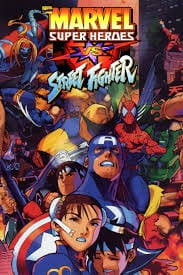
Marvel Super Heroes vs. Street Fighter

Introduction

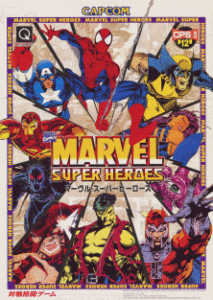
Marvel Super Heroes vs. Street Fighter was developed and published by Capcom on CPS-2 arcade hardware, released in 1997 as the second entry in Capcom’s Vs. series, following 1996’s X-Men vs. Street Fighter. The game replaced the previous entry’s X-Men roster with characters from across the wider Marvel Comics universe, including Spider-Man, Hulk, Captain America, and Venom, pitting them in tag-team two-on-two battles against Capcom’s own Street Fighter cast such as Ryu, Chun-Li, and Cammy. Building on X-Men vs. Street Fighter’s tag mechanics, the game refined the assist and team-super systems and introduced new combo possibilities as players learned to chain together both fighters’ abilities more fluidly. Its roster expansion beyond a single Marvel property into a broader crossover format proved to be a turning point for the series, setting up the far larger, franchise-spanning combination that would follow a year later in Marvel vs. Capcom: Clash of Super Heroes. Marvel Super Heroes vs. Street Fighter is often remembered as the pivotal middle chapter that transformed a promising experiment into one of fighting gaming’s most enduring crossover franchises.

Marvel Super Heroes vs. Street Fighter

How to Play Marvel Super Heroes vs. Street Fighter Online

Press Start Game above, insert a coin with Select and press Start. You pick two characters and can switch between them during the match. The game uses the six-button Capcom layout (three punches and three kicks). A gamepad is recommended, but the keyboard works too; open Control Settings in the emulator menu to see or change every key.

Controls

Input Action
Joystick Move, jump, crouch; hold back to block
Light / Medium / Heavy Punch Punches
Light / Medium / Heavy Kick Kicks
Heavy Punch + Heavy Kick Tag in your partner
Special motion + two buttons Hyper Combo using the Hyper Combo gauge

Tips

  • Rotate your team. The resting partner recovers part of their lost health, so tag before one fighter gets too low.
  • Air combos win rounds. Launch your opponent with a heavy attack and chase them with jumping attacks.
  • Mix big and small characters. Pair a fast fighter like Spider-Man or Chun-Li with a heavy hitter like Hulk or Zangief to cover each other’s weaknesses.
  • Store meter for a Variable Combination, where both partners unleash Hyper Combos at the same time.

Characters

The Marvel side includes Cyclops, Wolverine, Captain America, Spider-Man, Hulk, Omega Red, Blackheart and Shuma-Gorath, facing Street Fighter characters such as Ryu, Ken, Chun-Li, Zangief, Dhalsim, M. Bison, Sakura, Akuma and Dan. The final boss is Cyber-Akuma, and several hidden characters can be selected with codes on the character select screen.

History

Capcom released the game in arcades in 1997 as the follow-up to X-Men vs. Street Fighter, expanding the cast to the wider Marvel universe. Its tag-team gameplay led directly to Marvel vs. Capcom: Clash of Super Heroes. Fans of Capcom fighting games can also play Street Fighter Alpha and Super Street Fighter II.
Similar Posts

  • World Heroes Perfect

    Introduction World Heroes Perfect was developed by ADK in conjunction with SNK, released for the Neo Geo MVS arcade system on May 25, 1995, as the fourth and final entry in the World Heroes fighting game series. The game compiled the largest roster in series history by combining nearly every playable character introduced across the…

  • Magic Sword: Heroic Fantasy

    Introduction Magic Sword: Heroic Fantasy was developed and published by Capcom, released in arcades in 1990 as a side-scrolling action game built around a straightforward but addictive premise: fighting upward through a 50-floor tower to rescue prisoners trapped on each level while battling toward a final confrontation with the demon lord Drokmar. Players control a…

  • Garou: Mark of the Wolves

    Introduction Garou: Mark of the Wolves was developed and published by SNK, released for the Neo Geo MVS arcade system in 1999 as a spiritual successor to the long-running Fatal Fury series, set roughly a decade after the events of Fatal Fury 3 with an almost entirely new cast of playable fighters. The game introduced…

  • Gunbird

    Introduction Gunbird was developed and published by Psikyo, released in arcades in 1994 as one of the studio’s earliest shoot ’em up releases, distinguishing itself from typical military-themed shooters of the era with a colorful, fantasy-adventure setting. Players choose from a roster of unusual protagonists, including a witch, a ninja, and a genie, each piloting…

  • Money Puzzle Exchanger

    Introduction Money Puzzle Exchanger was developed by Face and released for the Neo Geo arcade system in 1997. Its twist on the competitive falling-block formula is built around Japanese coins: coins of 1, 5, 10, 50, 100 and 500 are pulled down from the top of the playfield, and the player gathers them and pushes…

  • Galaxian

    Introduction Galaxian was developed and published by Namco, released in arcades in 1979 as the company’s answer to the runaway success of Taito’s Space Invaders the year before. Players control a starship at the bottom of the screen, firing upward at a formation of alien insect-like enemies that, unlike the steadily advancing rows in Space…