X-Men vs. Street Fighter

Introduction

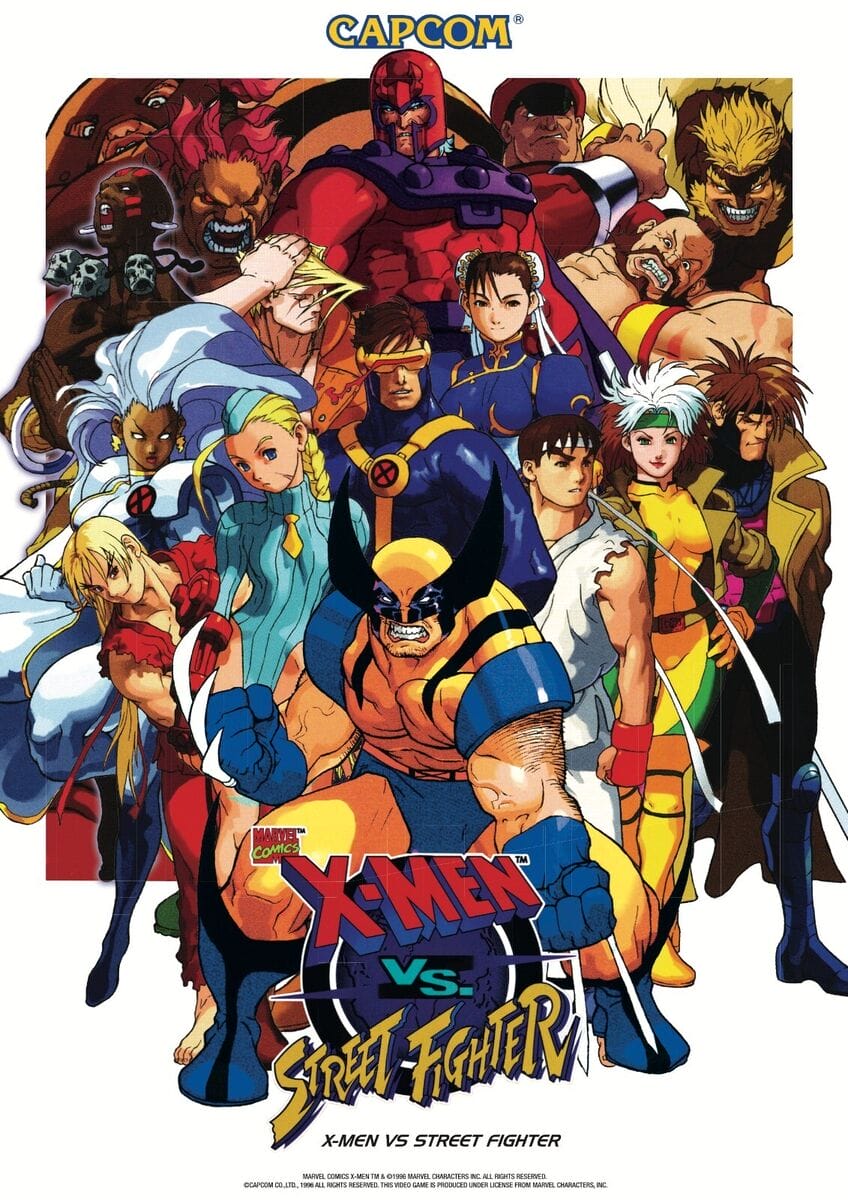
X-Men vs. Street Fighter was developed and published by Capcom on CPS-2 arcade hardware, released in Japan in September 1996 and reaching North American arcades that October. It holds the distinction of being the first tag-team fighting game in what would become Capcom’s long-running Vs. series, pairing characters from Marvel’s X-Men comics, including Wolverine, Cyclops, and Storm, against Capcom’s Street Fighter roster, such as Ryu, Chun-Li, and Guile. Players selected a team of two fighters and could tag between them mid-match or call in a partner for a brief assist attack, a “Cross Over Combination” mechanic that let both characters unleash their special moves simultaneously for a devastating team super. This two-on-two structure was a significant departure from the strictly one-on-one format of prior Street Fighter and Marvel fighting games, adding a fresh layer of team strategy and spectacle. Its success proved there was a strong audience for crossover team battles and directly paved the way for Marvel Super Heroes vs. Street Fighter and Marvel vs. Capcom, cementing the Vs. series as one of Capcom’s signature franchises.

X-Men vs. Street Fighter

How to Play X-Men vs. Street Fighter Online

Press Start Game above, insert a coin with Select and press Start. Choose two fighters, one on point and one in reserve, and switch between them during the match. The game uses the six-button Capcom layout. A gamepad is best, but the keyboard works too; check or remap the keys in Control Settings in the emulator menu.

Controls

Input Action
Joystick Move, jump, super jump (down then up); hold back to block
Light / Medium / Heavy Punch and Kick Attacks of three strengths
Heavy Punch + Heavy Kick Tag in your partner
Special motion + two buttons Hyper Combo using the Hyper Combo gauge

Tips

  • Launch and air combo. Most characters can launch with a crouching heavy attack, super jump after the opponent and finish with an aerial chain.
  • Tag safely. The incoming partner can be hit as they enter, so tag after knocking your opponent down.
  • Let the reserve fighter heal. The character waiting off screen recovers part of their lost health.
  • Save meter for a Hyper Combo that ends a long combo or punishes a whiffed attack.
  • Pick complementary pairs, such as a fast fighter with a heavy hitter.

Characters

The X-Men side includes Wolverine, Cyclops, Storm, Rogue, Gambit, Sabretooth, Juggernaut and Magneto, while Street Fighter brings Ryu, Ken, Chun-Li, Cammy, Charlie, Dhalsim, Zangief, M. Bison and Akuma. The final boss is Apocalypse.

History

Capcom released X-Men vs. Street Fighter in 1996 as the first of its tag-team crossover fighters. It was followed by Marvel Super Heroes vs. Street Fighter and Marvel vs. Capcom. For the earlier one-on-one X-Men game, try X-Men: Children of the Atom.
Similar Posts

  • Raiden Fighters

    Introduction Seibu Kaihatsu released Raiden Fighters in arcades in 1996, a spin-off from its Raiden shooting series. Instead of piloting a single ship, players choose from a selection of fighter jets, each with a different speed and its own main weapon and missile type, and more aircraft can be unlocked with hidden inputs. The game…

  • Art of Fighting

    Introduction Art of Fighting was developed and published by SNK, released for the Neo Geo MVS arcade system in 1992 as the studio’s second major fighting game franchise, set as a prequel within the same shared universe as SNK’s earlier Fatal Fury series. The game follows martial artist Ryo Sakazaki and his sister Yuri as…

  • Sengoku 2

    Introduction Sengoku 2 was developed and published by SNK, released for the Neo Geo MVS arcade system in 1993 as the direct sequel to 1991’s Sengoku. The game preserved the original’s core premise of fighting through supernatural, folklore-inspired enemies across a Japan menaced by dark magic, while refining the combat with a more varied moveset…

  • Fatal Fury Special

    Introduction Fatal Fury Special was developed and published by SNK, produced by Eikichi Kawasaki with design by Takashi Tsukamoto, released to Neo Geo arcades in September 1993 as an expanded update of the previous year’s Fatal Fury 2. Rather than a full sequel, it reworked that game’s roster and balance, promoting four previously CPU-only boss…