Marvel Super Heroes

Introduction

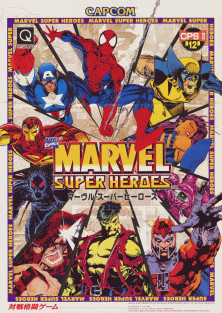
Marvel Super Heroes was developed and published by Capcom on CPS-2 arcade hardware, released in November 1995 as the studio’s second Marvel-licensed fighting game, following 1994’s The Punisher, and its first entry built around a proper Marvel Comics superhero roster rather than a single licensed property. Loosely adapting Marvel’s Infinity Gauntlet comic book storyline, the game lets players choose from heroes and villains including Spider-Man, Wolverine, Hulk, Captain America, and Thanos, battling across stages themed around iconic Marvel locations while collecting powerful Infinity Gems that grant temporary special abilities mid-match, from health regeneration to devastating limited-use super attacks. The Infinity Gem mechanic added a genuinely unique strategic layer not found in Capcom’s Street Fighter or Darkstalkers lines, rewarding players who could control gem pickups as much as those who mastered each character’s traditional special moves. Marvel Super Heroes proved popular enough to establish Marvel characters as a viable, ongoing presence in Capcom’s arcade lineup, directly setting up the crossover experiments that followed the next year with X-Men vs. Street Fighter and the wider Vs. series that grew from it.
Marvel Super Heroes

Similar Posts

  • The Last Blade

    Introduction The Last Blade, released in Japan as Bakumatsu Roman: Gekka no Kenshi, was developed and published by SNK, released for the Neo Geo MVS arcade system on December 5, 1997, as a weapon-based fighting game set during Japan’s Bakumatsu period, the turbulent final years of the Edo shogunate. Players choose from a roster of…

  • Cadillacs and Dinosaurs

    Introduction Cadillacs and Dinosaurs was developed and published by Capcom, released in arcades in April 1993 on the studio’s CPS-1 hardware. The game is based on Mark Schultz’s Xenozoic Tales comic book series and was timed to coincide with the short-lived Cadillacs and Dinosaurs animated series airing that same year. Set in a post-apocalyptic 26th…

  • Gunbird 2

    Introduction Gunbird 2 was developed by Psikyo and published by Capcom, released in Japanese arcades in 1998 as the sequel to 1994’s Gunbird. The game expanded on the original’s whimsical, character-driven premise with an even larger roster of unusual playable pilots, each again flying their own distinctly themed vehicle and wielding a unique weapon and…

  • Metal Slug 5

    Introduction Metal Slug 5 was developed by Noise Factory and published by SNK Playmore, released for the Neo Geo MVS arcade system in 2003 as the fifth mainline entry in the run-and-gun series. Following the mixed reception to the outsourced Metal Slug 4, SNK Playmore brought development back closer to the series’ original creative team’s…

  • 1943: The Battle of Midway

    Introduction 1943: The Battle of Midway was developed and published by Capcom, released in arcades in 1987 as the direct sequel to 1984’s 1942. Set once again during World War II, the game puts players back in the cockpit of a fighter plane, this time a Lockheed P-38 Lightning battling through a campaign loosely themed…

  • Raiden Fighters

    Introduction Seibu Kaihatsu released Raiden Fighters in arcades in 1996, a spin-off from its Raiden shooting series. Instead of piloting a single ship, players choose from a selection of fighter jets, each with a different speed and its own main weapon and missile type, and more aircraft can be unlocked with hidden inputs. The game…