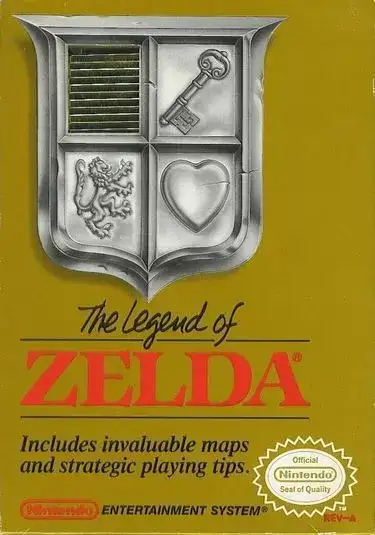
The Legend of Zelda

Introduction

The Legend of Zelda was developed by Nintendo R&D4, directed and produced by Shigeru Miyamoto with Takashi Tezuka as story writer, and built alongside Super Mario Bros as a launch title for the Family Computer Disk System, released in Japan in February 1986 before reaching the NES on cartridge in North America and Europe more than a year later. Miyamoto drew on his own childhood memories of exploring the countryside and hillside caves around his hometown for the game’s sense of open discovery, while Tezuka leaned on Tolkien-style fantasy for its story and setting. Players guide the hero Link across the overworld of Hyrule and through eight dungeons in search of pieces of the Triforce of Wisdom, fighting monsters, solving environmental puzzles, and buying or finding new equipment to reach previously inaccessible areas, all in a non-linear structure that let players tackle much of the adventure in an order of their own choosing. That open, item-gated exploration design was groundbreaking for a console game at the time and made The Legend of Zelda one of the most influential action-adventure titles ever made, spawning a franchise that has continued for decades.

The Legend of Zelda

How to Play The Legend of Zelda Online

Press Start Game above and wait for the NES emulator to load. On the title screen press Start, register a name and begin your quest across Hyrule. By default the arrow keys move Link and the Z and X keys are the NES buttons; check or change them in Control Settings in the emulator menu.

Controls

NES button Action
D-pad Walk in four directions
A Swing the sword
B Use the selected item (bombs, boomerang, candle, bow and more)
Start Open the item screen to choose the B item
Select Pause

Tips for New Adventurers

  • Take the sword first. Enter the cave right above the starting screen; the old man inside gives Link his first sword.
  • Bomb suspicious walls in dungeons and on mountain sides. Many shops, upgrades and shortcuts are hidden behind cracked rock.
  • Burn bushes with the candle, since some hide secret stairs.
  • Keep your hearts full. With full health, Link’s sword shoots a beam that hits enemies from a distance.
  • Buy the blue ring as soon as you can afford it; it halves the damage you take.
  • Use the map and compass found in each dungeon to locate the boss and the Triforce piece.

The Quest

Ganon has captured Princess Zelda and stolen the Triforce of Power. Link must explore the overworld, find eight hidden dungeons, collect the eight pieces of the Triforce of Wisdom, and then enter Death Mountain to face Ganon. After finishing the game you unlock a harder Second Quest with rearranged dungeons.

Legacy

The Legend of Zelda launched one of Nintendo’s biggest series and is remembered for its open world, hidden secrets and battery save. Continue with Zelda II: The Adventure of Link, or try other NES adventures such as Metroid and Crystalis.
Similar Posts

  • Adventures of Lolo 3

    Introduction HAL Laboratory released Adventures of Lolo 3 for the NES in 1991, the final entry in the western Lolo trilogy. King Egger has once again turned the people of Eden to stone, and this time both Lolo and Lala are playable, with the player able to switch between them. Instead of a simple series…

  • Dragon Warrior II

    Introduction Dragon Warrior II, known in Japan as Dragon Quest II, was developed by Chunsoft and published by Enix, again written and designed by series creator Yuji Horii with Koichi Nakamura directing, character art from Akira Toriyama, and music by Koichi Sugiyama. It released for the Famicom in Japan in January 1987 and reached the…

  • ToeJam & Earl

    Introduction ToeJam & Earl was developed by Johnson Voorsanger Productions and published by Sega, released for the Genesis in 1991 as an unconventional blend of action, exploration, and roguelike-inspired design. Players control ToeJam and Earl, two alien rappers whose spaceship crashes on Earth, scattering its pieces across a series of randomly generated, procedurally shuffled islands…

  • Teenage Mutant Ninja Turtles

    Introduction Teenage Mutant Ninja Turtles was developed by Konami and published in North America under its Ultra Games imprint, a label Konami founded in 1988 specifically to get around Nintendo’s limits on how many titles a single publisher could release per year. The game reached the Famicom in Japan in May 1989 and the NES…

  • River City Ransom

    Introduction River City Ransom was developed and published by Technos Japan, directed by Mitsuhiro Yoshida and Hiroyuki Sekimoto with music by Kazuo Sawa, and released in Japan in April 1989 as the first game the studio built specifically for a home console rather than adapting from arcades. It’s the third entry in the Kunio-kun series…

  • Little Nemo: The Dream Master

    Introduction Little Nemo: The Dream Master was developed and published by Capcom, released on the NES in September 1990, loosely based on the 1989 animated film Little Nemo: Adventures in Slumberland, itself adapted from Winsor McCay’s pioneering early-1900s newspaper comic strip. Players guide young Nemo through a dreamlike platforming world, using handfuls of candy to…