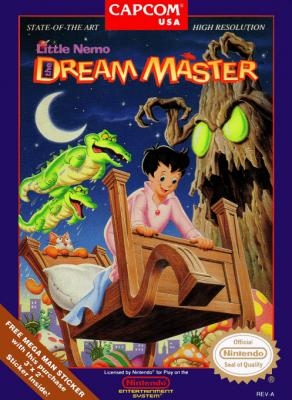
Little Nemo: The Dream Master

Introduction

Little Nemo: The Dream Master was developed and published by Capcom, released on the NES in September 1990, loosely based on the 1989 animated film Little Nemo: Adventures in Slumberland, itself adapted from Winsor McCay’s pioneering early-1900s newspaper comic strip. Players guide young Nemo through a dreamlike platforming world, using handfuls of candy to tame wild animals he encounters, riding them briefly to gain new abilities like a frog’s high jump, a mole’s digging, or a bee’s flight, before the transformed creature eventually breaks free and needs to be tamed again. That candy-and-animal mechanic gave Little Nemo a distinctly different rhythm from most contemporary platformers, blending puzzle-like timing with traditional jumping and dodging as players worked to reach the Nightmare King’s realm and rescue Nemo’s friends. Its whimsical, dreamlike visual style and inventive core mechanic helped it stand out in an NES library crowded with more conventional action platformers, and it remains fondly remembered as one of Capcom’s more creative and less-discussed contributions to the system’s later years.
Little Nemo: The Dream Master

Similar Posts

  • Kirby Super Star

    Introduction Kirby Super Star was developed by HAL Laboratory and published by Nintendo, released for the SNES in 1996 as a compilation of eight distinct sub-games built around Kirby’s signature Copy Ability. Rather than one continuous adventure, the game let players choose from varied experiences ranging from the sprawling platforming of Spring Breeze and Dyna…

  • The Legend of Zelda

    Introduction The Legend of Zelda was developed by Nintendo R&D4, directed and produced by Shigeru Miyamoto with Takashi Tezuka as story writer, and built alongside Super Mario Bros as a launch title for the Family Computer Disk System, released in Japan in February 1986 before reaching the NES on cartridge in North America and Europe…

  • Final Fantasy III

    Introduction Final Fantasy III was developed and published by Square, released for the Famicom in Japan in 1990 as the third entry in the series, notable for introducing the Job Change system that let party members switch freely between classes like Knight, Black Mage, and Dragoon rather than being locked into a single role for…

  • Tetris

    Introduction Tetris was originally designed and programmed in June 1984 by Soviet software engineer Alexey Pajitnov, and its Western publishing rights became the subject of a famously tangled licensing battle in the years that followed, with Andromeda Software, Mirrorsoft, Atari Games subsidiary Tengen, and Nintendo all fighting over who actually held the console rights. Tengen…

  • A Nightmare on Elm Street

    Introduction A Nightmare on Elm Street was published by LJN and developed by Rare, released for the NES in 1990 as a licensed adaptation of Wes Craven’s horror franchise, tasking players with controlling a group of Elm Street teenagers who must find and destroy Freddy Krueger’s bones before he can kill them in their dreams….

  • Lode Runner

    Introduction Lode Runner began as a 1983 computer game created by Doug Smith and published by Broderbund, and Hudson Soft brought it to the Famicom in 1984, with the NES version reaching North America in 1987. The player controls a runner who must collect every pile of gold on the screen while avoiding robotic guards….