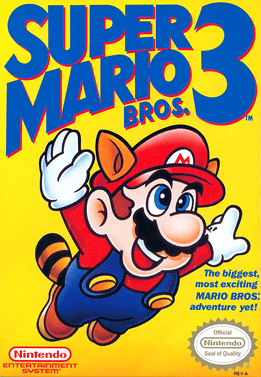
Super Mario Bros. 3

Introduction

Super Mario Bros. 3 was developed by Nintendo EAD under director Shigeru Miyamoto and lead designer Takashi Tezuka, with development beginning right after 1986’s Super Mario Bros.: The Lost Levels and running roughly two and a half years before its Japanese release in October 1988; North America had to wait until February 1990. Miyamoto has said he conceived the whole game as a stage play, an idea reflected directly in the NES version’s title-screen curtain reveal and in-level objects that hang from visible catwalks or cast shadows against a painted-looking backdrop. Players guide Mario or Luigi across a Super Mario Bros.-style overworld map rebuilt into eight themed kingdoms, collecting a much larger toolbox of power-ups than the original game offered, including the Raccoon Leaf for flight and tail attacks and the Frog Suit for underwater stages, on the way to reclaiming each kingdom’s stolen magic wand from a Koopaling before finally confronting Bowser. Its expanded scope, inventive level gimmicks, and generous power-up variety are widely credited with elevating the platforming genre and are still frequently cited among the best games ever made for the console.

Super Mario Bros. 3

How to Play Super Mario Bros. 3 Online

Press Start Game above and wait for the NES emulator to load, then press Start on the title screen. You move Mario across a world map, entering levels, Toad Houses and mini-games. By default the arrow keys are the D-pad and the Z and X keys are the NES buttons; check the exact layout or remap keys in Control Settings in the emulator menu.

Super Mario Bros. 3 Controls

NES button Action
D-pad Move, duck, enter pipes
A Jump; tap repeatedly to swim or slow a fall as Raccoon Mario
B Hold to run, pick up shells, throw fireballs or hammers, tail-swipe
Start Pause; open the item inventory on the world map

Power-ups You Will Find

  • Super Leaf (Raccoon Mario): run until the P-meter fills, then tap A to fly for a few seconds.
  • Tanooki Suit: flies like the leaf and lets Mario turn into an invincible statue by pressing Down + B.
  • Frog Suit: makes swimming easy in water stages.
  • Hammer Suit: throws hammers in an arc and blocks fireballs while ducking.
  • P-Wing: keeps the P-meter full for a whole level, so Mario can fly anywhere.

Tips and Secrets

  • Find the Warp Whistles. In World 1-3, stand on the white block near the end and hold Down for a few seconds to drop behind the scenery, then run to the end to reach a Toad House with a whistle. Whistles warp you to later worlds.
  • Use items before a level, not during. Open the inventory on the map with Start and pick a power-up for hard stages or airships.
  • Collect cards at the goal. Three matching cards (mushroom, flower or star) give extra lives.
  • Play N-Spade. The card-matching game appears after high scores and can give several extra lives.

The Eight Worlds

Mario and Luigi travel through Grass Land, Desert Land, Water Land, Giant Land, Sky Land, Ice Land, Pipe Land and Dark Land. Each world ends with an airship flown by one of Bowser’s seven Koopalings, who have stolen the kings’ magic wands, before the final showdown with Bowser.

More Mario on CraazyGames

Super Mario Bros. 3 is often ranked among the best games ever made. Play where it started with Super Mario Bros., try the very different Super Mario Bros. 2, or jump to the 16-bit era with Super Mario World.
Similar Posts

  • Crystalis

    Introduction Crystalis was developed and published by SNK, known in Japan as God Slayer: Haruka Tenkū no Sonata, directed and produced by Kazuto Kohno with programming from Yukio Gu, F. Sasami, and Satoru Okada and a soundtrack by Yoko Osaka, releasing there in April 1990 before reaching North America that July. It marked a notable…

  • Flashback

    :DESCRIPTION Flashback, released as Flashback: The Quest for Identity in the United States, is a 1992 science fiction cinematic platform game developed by Delphine Software of France and published by U.S. Gold in United States and Europe, and Sunsoft in Japan. The game was directed, written/designed and partially programmed by Paul Cuisset, who had previously…

  • Battle City

    Introduction Namco released Battle City for the Famicom in 1985, a tank shooter played on a single screen viewed from above. The player commands a tank whose mission is to defend a base marked by an eagle from waves of enemy tanks. Each stage is made of brick walls that can be destroyed, steel walls…

  • Kirby Super Star

    Introduction Kirby Super Star was developed by HAL Laboratory and published by Nintendo, released for the SNES in 1996 as a compilation of eight distinct sub-games built around Kirby’s signature Copy Ability. Rather than one continuous adventure, the game let players choose from varied experiences ranging from the sprawling platforming of Spring Breeze and Dyna…