River City Ransom

Introduction

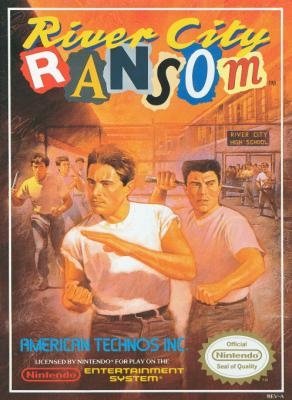
River City Ransom was developed and published by Technos Japan, directed by Mitsuhiro Yoshida and Hiroyuki Sekimoto with music by Kazuo Sawa, and released in Japan in April 1989 as the first game the studio built specifically for a home console rather than adapting from arcades. It’s the third entry in the Kunio-kun series created by designer Yoshihisa Kishimoto, following the original arcade brawler and Super Dodge Ball, and it reached North America in January 1990 retitled by Technos’s US subsidiary as its first console release handled without the involvement of prior series publisher Taito. Where earlier Kunio-kun games followed a fixed linear path, River City Ransom opened the format up into a genuinely non-linear town players could explore freely, fighting rival gang members for cash that can be spent in shops on food and items that permanently boost stats like strength, defense, and punch power, blending beat ’em up combat with light RPG-style progression years before that combination became common. Players, controlling Kunio or his friend Riki, work through River City’s schools and streets to rescue Kunio’s girlfriend from a rival gang leader, and the game’s mix of freeform exploration, comedic dialogue, and stat-building combat has made it a cult favorite that’s been remade and re-released many times since.
River City Ransom

Similar Posts

  • Super Mario Bros

    Introduction Super Mario Bros is a side-scrolling platform game directed by Shigeru Miyamoto and Takashi Tezuka for Nintendo’s in-house R&D4 team, released for the Famicom in Japan in September 1985 and for the NES in North America shortly after. Miyamoto had joined Nintendo as an artist and toy designer and originally pitched a game built…

  • Contra Force

    Introduction Contra Force was developed and published by Konami, programmed by Mitsuo Takemoto with art from Koji Horie and a score by Kenichi Matsubara and Tomoya Tomita, releasing in North America in September 1992 as the third NES entry carrying the Contra name after the original Contra and Super C. Its history is unusual for…

  • Metroid

    Introduction Metroid was developed by Nintendo R&D1 under producer Gunpei Yokoi, first released for the Famicom Disk System in Japan in August 1986 before arriving on cartridge for the NES in North America the following year. The team set out to blend Super Mario Bros’s side-scrolling action with The Legend of Zelda’s open, non-linear exploration,…

  • Hudson’s Adventure Island II

    Introduction Hudson Soft released Adventure Island II for the NES in 1991, the follow-up to the original Hudson’s Adventure Island. Master Higgins once again sets out to rescue Tina, travelling across eight islands filled with forests, deserts, caves, volcanoes and icy lands. The core gameplay remains fast side-scrolling action: Higgins runs, jumps and throws stone…

  • Mega Man

    Introduction Mega Man was developed and published by Capcom, released for the Famicom in Japan in December 1987 by a small six-person team working under a project supervisor who reportedly pushed for perfection in every detail despite the tight crew size. Fresh Capcom hire Keiji Inafune, credited on the game as ‘Inafuking,’ designed and illustrated…

  • Tetris

    Introduction Tetris was originally designed and programmed in June 1984 by Soviet software engineer Alexey Pajitnov, and its Western publishing rights became the subject of a famously tangled licensing battle in the years that followed, with Andromeda Software, Mirrorsoft, Atari Games subsidiary Tengen, and Nintendo all fighting over who actually held the console rights. Tengen…