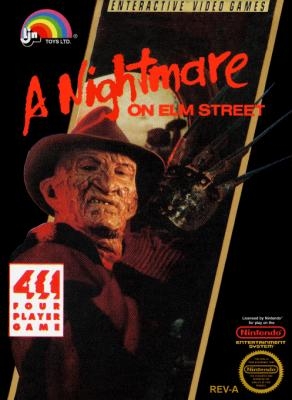
A Nightmare on Elm Street NES box art

A Nightmare on Elm Street

Introduction

A Nightmare on Elm Street was published by LJN and developed by Rare, released for the NES in 1990 as a licensed adaptation of Wes Craven’s horror franchise, tasking players with controlling a group of Elm Street teenagers who must find and destroy Freddy Krueger’s bones before he can kill them in their dreams. The game alternates between a real-world overworld, where players search houses and collect items while avoiding sleep-inducing yawns that pull characters into danger, and dream sequences where Freddy himself appears as a boss fight requiring specific collected items to defeat. Its structure combined light RPG-style exploration and resource management with more traditional platforming dream stages, an ambitious mix for a licensed horror game of its era, though it was often criticized for confusing mechanics and steep difficulty. Frequently cited alongside other notoriously rough licensed NES titles, it has nonetheless earned a place in retro gaming discussions as a curious, ambitious attempt to translate a horror franchise’s dream-logic premise into an NES game mechanic.
A Nightmare on Elm Street

Similar Posts

  • Scooby-Doo Mystery

    Introduction Scooby-Doo Mystery was developed by Illusions Gaming Company and published by Acclaim Entertainment in partnership with Warner Bros. Interactive, released for the Genesis in September 1995 as a licensed adaptation of the classic Scooby-Doo, Where Are You! animated series. Unlike the more action-oriented platformers typical of licensed Genesis games, Scooby-Doo Mystery leaned into a…

  • Wario’s Woods

    Introduction Nintendo released Wario’s Woods in 1994 for both the NES and the Super Nintendo, and the NES version is known as the last game Nintendo itself published for the console in North America. Wario has taken over the Peaceful Woods and filled it with monsters, and Toad sets out to clear them with help…

  • Final Fantasy III

    Introduction Final Fantasy III was developed and published by Square, released for the Famicom in Japan in 1990 as the third entry in the series, notable for introducing the Job Change system that let party members switch freely between classes like Knight, Black Mage, and Dragoon rather than being locked into a single role for…

  • Super Dodge Ball

    Introduction Super Dodge Ball was developed and published by Technos Japan, directed by Mitsuhiro Yoshida with design work by Koji Ogata, loosely adapting the studio’s own 1987 arcade game of the same name and serving as the second entry in the Kunio-kun series even though that connection was scrubbed from international releases. It launched in…

  • Hudson’s Adventure Island

    Introduction Hudson’s Adventure Island was developed and published by Hudson Soft, released on the NES in 1988 as a loose adaptation of Sega’s 1986 arcade game Wonder Boy, reworked with an original cast and story after Hudson lost the rights to use Sega’s characters directly. Players control Master Higgins, a shirtless island adventurer racing left…

  • Super Metroid

    Description Super Metroid is an action-adventure video game and the third game in the Metroid series; the introduction alternatively refers to the game as Metroid 3. It was designed by Nintendo Research & Development 1, programmed by Intelligent Systems, and published by Nintendo for the Super Nintendo Entertainment System video game console. The game was…