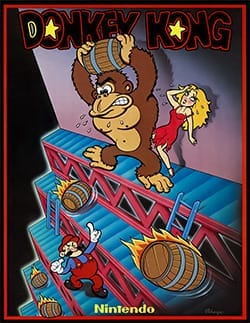
Donkey Kong (Arcade)
Introduction
Donkey Kong is Nintendo’s original 1981 arcade platformer, the coin-operated cabinet that later inspired the NES home conversion, built around four distinct single-screen stages that each represent 25 meters of a construction site Mario, then called Jumpman, must climb to rescue Pauline from the giant ape Donkey Kong. The first stage has players navigating crooked girders and ladders while dodging barrels and oil drums hurled from above; the second sends them up a five-story tower of conveyor belts carrying cement pans; the third involves riding elevators while avoiding bouncing springs; and the fourth and final stage requires knocking out eight rivets holding up the platform Donkey Kong stands on, sending him crashing down and reuniting Mario with Pauline. Every element of the arcade original, from its scoring system to its now-iconic barrel-jumping mechanics, was built around the tight constraints of early-80s arcade hardware, yet its clear stage goals and readable hazards made it instantly approachable in a way many contemporaries weren’t. As Nintendo’s first true platformer and the game that introduced the character who would become Mario, the arcade version of Donkey Kong holds a foundational place in gaming history well beyond its own considerable commercial success.