Tetris
Introduction
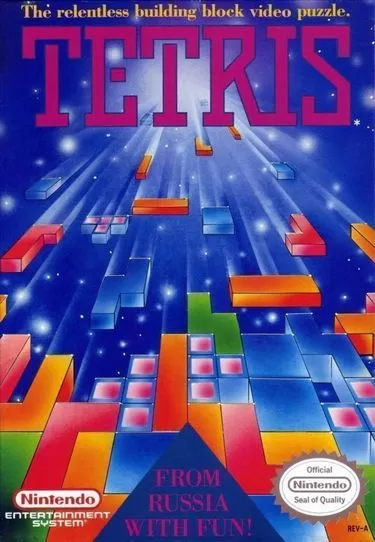
Tetris was originally designed and programmed in June 1984 by Soviet software engineer Alexey Pajitnov, and its Western publishing rights became the subject of a famously tangled licensing battle in the years that followed, with Andromeda Software, Mirrorsoft, Atari Games subsidiary Tengen, and Nintendo all fighting over who actually held the console rights. Tengen released its own unlicensed NES cartridge in May 1989, but Nintendo won the legal dispute over exclusive console rights and released its own officially licensed NES version later that same year, which went on to sell roughly 8 million copies worldwide and became the version most players associate with the console. The game itself needs little introduction: falling tetromino pieces must be rotated and slotted together to clear horizontal lines before the stack reaches the top of the well, with speed increasing every level to keep the pressure constant. Its addictive, endlessly replayable simplicity made Tetris one of the best-selling and most influential puzzle games ever made, and its Nintendo NES release played a major role in cementing the format’s mainstream popularity in North America.
Tetris
How to Play Tetris Online
Press Start Game above and wait for the NES emulator to load, then press Start. Choose game type A or B, a starting level and a music track. By default the arrow keys move and drop pieces and the Z and X keys rotate them; check or change the layout in Control Settings in the emulator menu.
NES Tetris Controls
| NES button | Action |
|---|---|
| Left / Right | Move the piece |
| Down | Soft drop (there is no hard drop in this version) |
| A | Rotate clockwise |
| B | Rotate counterclockwise |
| Select | Show or hide the next piece |
| Start | Pause |
Game Types
- A-Type: endless marathon. Every ten lines raises the level and the speed. Play as long as you can.
- B-Type: clear 25 lines to win, starting with a chosen height of random garbage blocks.
Tips for Higher Scores
- Go for Tetrises. Clearing four lines at once with the long I piece scores far more than clearing them one by one.
- Keep one column open, usually at the edge, and stack everything else flat beside it, waiting for an I piece.
- Keep the next piece visible so you can plan where both pieces will go.
- Avoid holes. A covered gap forces you to clear the lines above it first.
- Start at a higher level once you are comfortable; points per line grow with the level.
History
Alexey Pajitnov created Tetris in 1984, and Nintendo’s 1989 NES version became one of the best-known editions. Decades later it is still the version used at the Classic Tetris World Championship, where top players reach extreme speeds. For more falling-block puzzles, try Tetris & Dr. Mario, Dr. Mario or Tetris Attack.