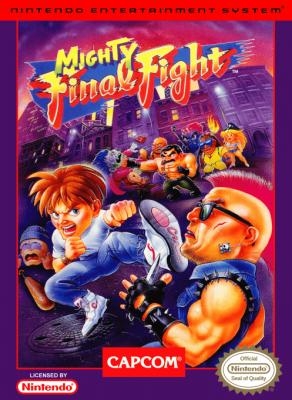
Mighty Final Fight

Introduction

Mighty Final Fight was developed and published by Capcom, produced by Tokuro Fujiwara, and released in Japan in June 1993 before reaching North America that July, arriving as a spinoff of the studio’s own 1989 arcade brawler Final Fight rather than a direct port. Its most immediately obvious change is the art style: the realistically proportioned brawlers from the arcade original are reimagined as small, big-headed ‘chibi’ versions of themselves, giving the game a much more cartoonish, comical look than its source material despite keeping all three original playable characters, Cody, Guy, and Haggar, alongside chibi versions of the arcade game’s enemy roster. Underneath the cute presentation, the NES version also adds an experience-point leveling system uncommon for beat ’em ups of the era, letting players’ characters grow stronger and unlock new moves as they clear waves of Mad Gear gang members across the game’s side-scrolling stages. That mix of an unusually cute reinterpretation of a gritty arcade brawler with genuine RPG-lite progression has made Mighty Final Fight a cult favorite that stands apart from typical console beat ’em up ports of its time.
Mighty Final Fight

Similar Posts

  • Altered Beast

    Introduction Altered Beast was developed and published by Sega, released in arcades in 1988 before becoming one of the launch titles for the Sega Genesis later that year. Loosely inspired by Greek mythology, the game casts players as a Roman centurion resurrected by the god Zeus and tasked with rescuing his daughter Athena from the…

  • The Ninja Warriors

    Introduction Taito developed and published The Ninja Warriors in 1987, with cabinets reaching operators in February 1988. Its defining feature was hardware rather than software: the cabinet housed three contiguous monitors, the outer two reflected into place by mirrors, producing an extraordinarily wide playfield that no home console of the era could reproduce faithfully. The…

  • Kunio-kun no Nekketsu Soccer League

    Introduction Kunio-kun no Nekketsu Soccer League was developed and published by Technos Japan, released for the Famicom as a soccer entry in the Kunio-kun series, the same delinquent-school franchise behind River City Ransom and Nekketsu Fighting Legend. True to the series’ exaggerated style, matches favor chaotic, arcade-style soccer over simulation, with players able to pull…

  • Mega Man 6

    Introduction Mega Man 6 was developed by Capcom and released in Japan in October 1993, but by that point Capcom’s Japanese arm had largely moved on from the aging NES, so for the first time Nintendo of America stepped in to co-fund and publish the game in the West itself, bringing it to North America…

  • Dragon Warrior II

    Introduction Dragon Warrior II, known in Japan as Dragon Quest II, was developed by Chunsoft and published by Enix, again written and designed by series creator Yuji Horii with Koichi Nakamura directing, character art from Akira Toriyama, and music by Koichi Sugiyama. It released for the Famicom in Japan in January 1987 and reached the…

  • Bomberman

    Introduction Bomberman traces back to a 1983 original created by programmer Yuji Tanaka for Hudson Soft, a Sapporo-based company that had started out selling art supplies and telecommunications gear before moving into home computers and eventually games. This 1985 Famicom/NES version, reportedly ported single-handedly by Shinichi Nakamoto over a marathon 72-hour stretch, is widely considered…