Dragon’s Fury

Introduction

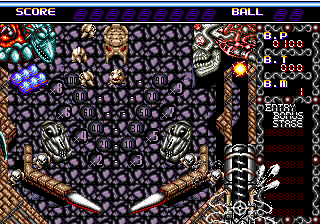
Dragon’s Fury, released in Japan as Devil Crash MD, was developed by Compile with the Genesis port handled by Technosoft, released for the Genesis on October 10, 1991, as a spiritual continuation of Compile’s earlier TurboGrafx-16 pinball game Devil’s Crush. The game combines traditional pinball mechanics with a dark fantasy theme, featuring a demon-headed playfield packed with dragons, skulls, and occult imagery, along with animated enemy creatures that can be defeated mid-game for bonus points and progression through a loosely structured campaign layered on top of standard pinball scoring. Its flippers, bumpers, and ramps were designed with genuine pinball-table logic in mind rather than simply serving as a backdrop, giving it real mechanical depth alongside its striking, unusually grim visual presentation for the genre. Dragon’s Fury built a strong cult following for successfully translating physical pinball’s tactile, skill-based scoring systems into a home console format while adding just enough fantasy-RPG flavor to give it a distinct identity, and it remains one of the most fondly remembered pinball games on the Genesis.

↑ = up
→ = right
↓ = down
← = left

Z = A Button
X = B Button
A = X Button
S = Y Button

Q = L Button
E = R Button

Shift = Select
Enter = Start
Dragon’s Fury

Similar Posts

  • Air Diver

    Introduction Air Diver is a first-person combat flight simulator developed by Copya System and published by Asmik in Japan in March 1990, with a North American release by Seismic that April, for the Sega Genesis. Players pilot the fictional F-119D stealth fighter from an in-cockpit view, battling waves of enemy aircraft and ground targets across…

  • Space Harrier II

    Introduction Space Harrier II is a rail shooter developed by Sega and designed by Yu Suzuki, released as one of the two launch titles for the Mega Drive in Japan on October 29, 1988, alongside Super Thunder Blade, before reaching North America the following year as one of the Genesis’s six US launch games. It…

  • Bust-A-Move

    Description Puzzle Bobble also known as Bust-a-Move, is a 1994 tile-matching arcade puzzle video game for one or two players created by Taito Corporation. It is based on Taito’s popular 1986 arcade game Bubble Bobble, featuring characters and themes from that game. Its characteristically ‘cute’ Japanese animation and music, along with its play mechanics and…

  • Streets of Rage 3

    Introduction Streets of Rage 3 was developed and published by Sega, released for the Genesis in Japan in 1994 as the third entry in the Streets of Rage series, continuing directly from the story of Streets of Rage 2. The returning cast of Axel, Blaze, and Skate face off against the criminal syndicate boss Mr….

  • Sonic Spinball

    Introduction Sonic Spinball was developed by Sega Technical Institute and published by Sega, released for the Genesis in 1993 as a pinball spin-off built around Sonic the Hedgehog’s speed and physics rather than his usual platforming stages. Set across four large, interconnected pinball tables inside Dr. Robotnik’s volcanic base, players launch Sonic like a ball,…

  • Phantasy Star II

    Introduction Sega released Phantasy Star II for the Mega Drive in 1989, with the Genesis version arriving in North America the same year. Set about a thousand years after the first game, the Algol star system is managed by Mother Brain, a vast computer that controls the climate and supplies of the colonies. When the…