Marble Madness
Introduction
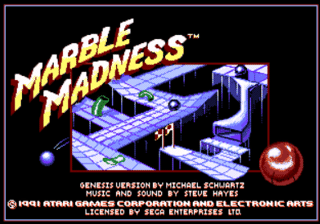
Marble Madness was originally developed by Atari Games and released as an arcade game in 1984, before being ported to the Genesis by Electronic Arts, reaching North America and Europe in November 1991 with reprogramming work handled by Michael Schwartz; a separate Japanese release, ported directly by Tengen, Atari’s home-console division, stayed closer to the original arcade version. Players guide a marble through a series of isometric 3D obstacle courses using a trackball-style control scheme adapted to the Genesis controller, racing against a strict time limit while avoiding pits, moving enemies, and hazards that could knock the marble off the course entirely. Its physics-driven momentum, requiring players to carefully manage speed and control on narrow, winding paths, gave it a distinctly different feel from the more conventional platformers and puzzle games that made up most of the Genesis library. As one of the earliest arcade games built around real-time physics-based movement rather than sprite collision alone, Marble Madness remains a historically significant title, and its Genesis port introduced a new generation of console players to a genre-defining physics puzzle-platformer from the arcade era.
↑ = up
→ = right
↓ = down
← = left
Z = A Button
X = B Button
A = X Button
S = Y Button
Q = L Button
E = R Button
Shift = Select
Enter = Start