Duck Hunt

Introduction

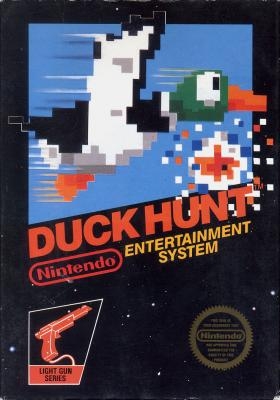
Duck Hunt was developed by Nintendo R&D1, the mostly hardware-focused team also behind the NES Zapper light gun itself, with Shigeru Miyamoto directing, Gunpei Yokoi producing, and Hiroji Kiyotake handling the game’s graphics and character designs. It first appeared in Japan in April 1984 for the Famicom and as an arcade cabinet, before becoming a launch-window title for the NES in North America in October 1985 and reaching Europe two years after that. The Zapper itself was a cosmetic redesign by Nintendo of America’s Lance Barr built on top of Yokoi’s earlier Japanese light gun hardware, and together the pairing let players physically aim at a CRT television to shoot ducks that flush out of tall grass, with a hunting dog popping up between rounds to retrieve downed birds or laugh at a missed shot. Its simple, physical, arcade-style gameplay helped popularize light gun games on home consoles and made Duck Hunt a genuine commercial phenomenon, selling more than 28 million copies worldwide and becoming one of the best-selling video games of its era.
Duck Hunt

Similar Posts

  • Gun.Smoke

    Introduction Gun.Smoke began as a 1985 Capcom arcade shooter designed by Yoshiki Okamoto, who would later oversee the studio’s biggest hits like Final Fight and Street Fighter II, with programming by Takashi Aoki and a soundtrack by Ayako Mori that helped make it one of Japan’s highest-grossing arcade games in early 1986. Capcom brought it…

  • Battletoads

    Introduction Battletoads was developed by Rare and published by Tradewest, designed by Tim and Chris Stamper with a soundtrack by David Wise, and built with the explicit goal of giving Rare its own answer to the era’s Teenage Mutant Ninja Turtles craze. It released on the NES in North America and Japan in June 1991,…

  • River City Ransom

    Introduction River City Ransom was developed and published by Technos Japan, directed by Mitsuhiro Yoshida and Hiroyuki Sekimoto with music by Kazuo Sawa, and released in Japan in April 1989 as the first game the studio built specifically for a home console rather than adapting from arcades. It’s the third entry in the Kunio-kun series…

  • Pac-Man

    Introduction Pac-Man’s NES history is unusually tangled for such a simple game. Namco’s original 1980 arcade maze-chase design was ported to the NES more than once: Tengen, then an Atari Games subsidiary, released a licensed version in October 1988 and later an unlicensed version after a falling-out with Nintendo over cartridge lockout chips and licensing…

  • Dr. Mario

    Introduction Nintendo released Dr. Mario on the NES and Game Boy on the same day in 1990, casting Mario as a doctor fighting an outbreak of red, yellow and blue viruses inside a medicine bottle. Two-coloured megavitamin capsules fall into the bottle, and the player rotates and positions them so that four or more of…

  • Double Dragon

    Introduction Double Dragon began as a 1987 arcade beat ’em up developed by Technos Japan and distributed by Taito, a spiritual successor to Technos’s earlier Nekketsu Kōha Kunio-kun that added two-player co-op and the ability to pick up and use a disarmed enemy’s own weapon, quickly becoming one of the genre’s foundational hits. Technos ported…