Kirby’s Adventure

Introduction

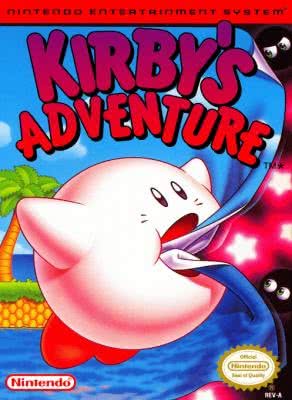
Kirby’s Adventure was developed by HAL Laboratory and published by Nintendo for the NES in 1993, directed and designed once again by Masahiro Sakurai with lead programming by Hiroaki Suga and production input from Satoru Iwata, Shigeru Miyamoto, and Takao Shimizu. Sakurai had originally been asked simply to port the Game Boy original, Kirby’s Dream Land, to the NES, but chose to build an entirely new game instead, reasoning that the console’s more experienced player base needed more depth than the beginner-friendly original offered. His solution was the series-defining Copy Ability, letting Kirby permanently gain a defeated enemy’s power, from fire breath to sword slashes, giving the game far more variety and replay value than its predecessor. Players guide the pink puffball across the Dream Land-set Vegetable Valley, Ice Cream Island, and other bright, whimsical worlds to recover the stolen pieces of the Star Rod from King Dedede, all wrapped in some of the most detailed, colorful visuals ever pushed out of the 8-bit NES hardware at the tail end of its commercial life.
Kirby’s Adventure

Similar Posts

  • Valis: The Fantasm Soldier

    Introduction Valis: The Fantasm Soldier was originally developed and published by Telenet Japan for Japanese home computers in 1986, before reaching the Genesis in 1991 through a port handled by Riot in Japan and Renovation in North America. The game follows Yuko Asou, an ordinary schoolgirl chosen to wield the legendary Valis sword and defend…

  • Double Dragon

    Introduction Double Dragon began as a 1987 arcade beat ’em up developed by Technos Japan and distributed by Taito, a spiritual successor to Technos’s earlier Nekketsu Kōha Kunio-kun that added two-player co-op and the ability to pick up and use a disarmed enemy’s own weapon, quickly becoming one of the genre’s foundational hits. Technos ported…

  • Elevator Action Returns

    Introduction Elevator Action Returns was developed and published by Taito, released in Japanese arcades in 1994 as the sequel to the studio’s 1983 original, Elevator Action. Players once again control a spy infiltrating tall, multi-floor buildings, riding elevators and escalators between levels while shooting enemy agents, collecting secret documents from marked red doors, and avoiding…

  • Gradius

    Introduction Gradius began as a 1985 arcade shoot ’em up from Konami, developed under the working title Scramble 2 as a spiritual successor to the studio’s earlier Scramble, and it became one of the biggest arcade hits of the following year. Konami ported it to the Famicom in April 1986 and brought it to the…

  • Mega Man X

    Introduction Mega Man X was developed and published by Capcom, released on the SNES in December 1993 as a reboot of the long-running Mega Man series set in a new timeline generations after the original NES games. Directed by series creator Keiji Inafune, the game introduces X, a more advanced Reploid robot capable of acquiring…