Dr. Robotnik’s Mean Bean Machine

Introduction

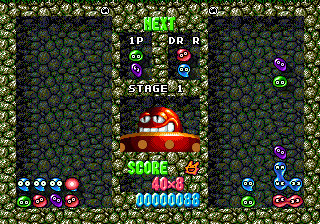
Dr. Robotnik’s Mean Bean Machine was developed by Compile and published by Sega, released for the Genesis in 1993 as a Western localization of Compile’s own 1991 Japanese puzzle game Puyo Puyo, reskinned with characters and setting from the Adventures of Sonic the Hedgehog animated series rather than Puyo Puyo’s original cast. Players drop pairs of colored beans into a vertical well, arranging them so that four or more matching beans connect to clear from the board, while sending garbage beans onto an opponent’s board when clearing large chains, turning single-player puzzle-solving into a genuinely competitive head-to-head format in its two-player mode. The game’s story frames the beans as captured citizens of Mobius transformed by Dr. Robotnik’s Bean-o-matic Machine, with Sonic tasked with defeating Robotnik’s Badniks to free them, giving an otherwise standalone Puyo Puyo adaptation a loose tie to the Sonic universe. Its accessible yet genuinely skill-rewarding puzzle mechanics made it a well-regarded entry in the falling-block puzzle genre, and it remains fondly remembered as one of the better Sonic-branded spin-offs released during the character’s early-1990s peak.

↑ = up
→ = right
↓ = down
← = left

Z = A Button
X = B Button
A = X Button
S = Y Button

Q = L Button
E = R Button

Shift = Select
Enter = Start
Dr. Robotnik’s Mean Bean Machine

Similar Posts

  • Super Buster Bros

    Description Super Buster Bros it is crazy games for play like. (Super Pang outside of the USA) is a cooperative two-player ‘Shooting Puzzle'[1] arcade video game developed by Mitchell and released in 1990 by Capcom. It is the second game in the Pang series and was later ported to Super Nintendo in 1992. It is…

  • Flashback

    :DESCRIPTION Flashback, released as Flashback: The Quest for Identity in the United States, is a 1992 science fiction cinematic platform game developed by Delphine Software of France and published by U.S. Gold in United States and Europe, and Sunsoft in Japan. The game was directed, written/designed and partially programmed by Paul Cuisset, who had previously…

  • Sonic Spinball

    Introduction Sonic Spinball was developed by Sega Technical Institute and published by Sega, released for the Genesis in 1993 as a pinball spin-off built around Sonic the Hedgehog’s speed and physics rather than his usual platforming stages. Set across four large, interconnected pinball tables inside Dr. Robotnik’s volcanic base, players launch Sonic like a ball,…

  • Shanghai II: Dragon’s Eye

    Introduction Shanghai II: Dragon’s Eye was developed and published by Activision, originally released for home computers in 1990 before reaching the Genesis in 1991 through a Japan-exclusive port by Home Data and a separate North American port by Activision itself in 1994, as the sequel to the original 1986 Shanghai. The game is built around…

  • Ecco the Dolphin

    Introduction Ecco the Dolphin was developed by Novotrade, designed by Ed Annunziata, and published by Sega, released for the Genesis in 1992 as an unusually atmospheric action-adventure game starring a bottlenose dolphin rather than a typical human or animal-mascot protagonist. Players guide Ecco through underwater environments after his pod is mysteriously swept away by a…

  • Kirby’s Avalanche

    Introduction Kirby’s Avalanche was published by Nintendo, released for the SNES in Europe in February 1995 and North America that April, as a Western localization built directly on top of 1993’s Super Puyo Puyo, with the original Puyo Puyo cast and most of its music replaced by characters and songs from the Kirby series. The…