Tetris Attack

Introduction

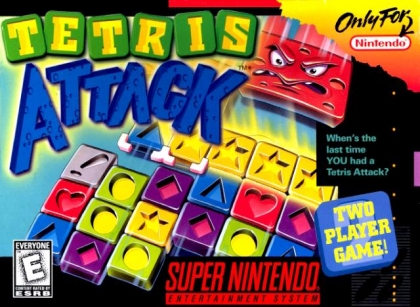
Tetris Attack, released in Japan as Panel de Pon, was developed by Intelligent Systems and published by Nintendo, produced by Game Boy creator Gunpei Yokoi, released for the SNES in Japan in October 1995 and internationally the following year. The Japanese version featured an original cast of fairy characters in a mythical fantasy setting, while the Western release replaced them with characters and settings from Super Mario World 2: Yoshi’s Island, borrowing the Tetris brand name for recognition despite having no actual mechanical relationship to falling-block Tetris gameplay. Players instead swap adjacent colored panels horizontally to arrange three or more matching panels in a row or column, clearing them before the steadily rising stack of panels reaches the top of the playfield, a real-time matching format that rewards quick pattern recognition and chain-building for bonus points. Its accessible core mechanic paired with genuinely deep chain-combo strategy made it a critical favorite, and the underlying Panel de Pon system proved influential enough to be reused for later Nintendo puzzle games, including entries in the Pokémon and Yoshi franchises.

Tetris Attack

Similar Posts

  • Doraemon 4

    Description Doraemon 4: Nobita to Tsuki no Oukoku, known simply as Doraemon 4 in the West, was developed and published by Epoch, released for the Super Famicom in 1995 as the fourth entry in the long-running Doraemon action-platformer series based on Fujiko F. Fujio’s manga. Nobita and his friends travel to the Moon Kingdom to…

  • Contra III: The Alien Wars

    Introduction Contra III: The Alien Wars was developed and published by Konami, released for the SNES in 1992 as the series’ debut on Nintendo’s 16-bit console. The game continued the run-and-gun formula of its NES predecessors while taking full advantage of the SNES’s Mode 7 scaling and rotation effects, alternating traditional side-scrolling stages with top-down…

  • Sonic Spinball

    Introduction Sonic Spinball was developed by Sega Technical Institute and published by Sega, released for the Genesis in 1993 as a pinball spin-off built around Sonic the Hedgehog’s speed and physics rather than his usual platforming stages. Set across four large, interconnected pinball tables inside Dr. Robotnik’s volcanic base, players launch Sonic like a ball,…

  • Super Castlevania IV

    Description Super Castlevania IV  is a platform game developed and published by Konami and the first Castlevania game for the Super Nintendo Entertainment System. The game was originally released in 1991 and later re-released on the Virtual Console in 2006 for the Wii[3] and in 2013 for the Wii U. It features expanded play control,…

  • Arkanoid

    Introduction Arkanoid was developed and published by Taito, released for the NES in 1987 as a home conversion of the 1986 arcade original that helped define the breakout-style genre. Players control the Vaus, a small spacecraft acting as a paddle, bouncing a ball upward to destroy grids of colored bricks across increasingly elaborate stages, with…

  • Tiny Toon Adventures: Buster Busts Loose!

    Introduction Tiny Toon Adventures: Buster Busts Loose! was developed and published by Konami, released for the SNES in 1993 as a platformer starring Buster Bunny navigating cartoon-logic stages based on the Tiny Toon Adventures animated series. Each level reimagines a different Looney Tunes-style scenario, from raiding Elmyra’s toy-filled bedroom to escaping a horror-movie parody mansion,…