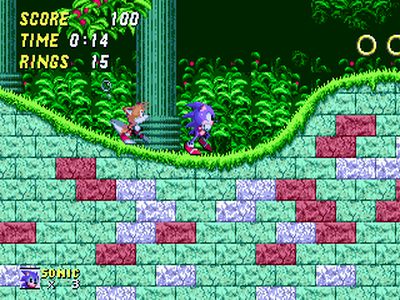
Sonic the Hedgehog 2

Introduction

Sonic the Hedgehog 2 was developed by Sonic Team, with additional programming support from Sega Technical Institute in the United States, released for the Genesis in November 1992 as the direct sequel to the original Sonic the Hedgehog. The game introduced Miles “Tails” Prower, a young two-tailed fox who could join Sonic as a second playable character or be controlled by a second player in simultaneous co-op, adding a companion dynamic the original game lacked. Building on the first game’s speed-focused platforming, the sequel added the Spin Dash move, letting players charge up a burst of speed while standing still rather than needing a running start, an addition that became a series staple used in nearly every Sonic game since. Its zones were built with even more elaborate looping and branching paths designed to reward mastery of momentum, and its two-player split-screen competitive mode added a genuine multiplayer option absent from the original. Sonic the Hedgehog 2 was both a critical and commercial triumph, widely regarded as one of the finest platformers on the Genesis and a high point of the entire Sonic series.

↑ = up
→ = right
↓ = down
← = left

Z = A Button
X = B Button
A = X Button
S = Y Button

Q = L Button
E = R Button

Shift = Select
Enter = Start

Sonic the Hedgehog 2

How to Play Sonic the Hedgehog 2 Online

Click inside the game window and press Start to load the Genesis emulator. Sonic 2 only needs a D-pad and one jump button, so it plays well on a keyboard: arrow keys to move and any of the Genesis A, B or C buttons to jump. On the default layout of this emulator Z, X and A are mapped to Genesis buttons and Enter is Start. A second player can control Tails on the same keyboard or with a gamepad.

Sonic the Hedgehog 2 Controls

Genesis button Action
D-pad Run left or right, look up, crouch
A / B / C Jump (spin attack)
Down while running Roll into a ball
Down + jump (hold Down, tap jump) Spin Dash: charge, then release Down
Start Pause

Tips for Sonic 2

  • Never run out of rings. As long as you hold at least one ring, a hit only scatters them instead of costing a life. Grab a few back right after you get hit.
  • Use the Spin Dash to get through loops and slopes from a standstill, especially in Chemical Plant Zone and Metropolis Zone.
  • Special Stages: pass a star post while holding 50 rings or more and a ring of stars appears above it. Jump in to enter the half-pipe Special Stage and collect enough rings to earn a Chaos Emerald.
  • Collect all seven Chaos Emeralds and you can turn into Super Sonic by jumping with 50 rings, becoming faster and invincible while your rings last.
  • Watch your air underwater in Chemical Plant and Aquatic Ruin. Stand over large air bubbles to breathe before the countdown hits zero.
  • Take the high road. Upper paths in most zones are faster and hold more rings and monitors.

Zones and Modes

The adventure runs through Emerald Hill, Chemical Plant, Aquatic Ruin, Casino Night, Hill Top, Mystic Cave, Oil Ocean, Metropolis, Sky Chase, Wing Fortress and finally the Death Egg, where Sonic faces Dr. Robotnik’s mechanical double. Besides the main game there is a two-player split-screen versus mode where Sonic and Tails race through selected zones.

Why It Still Matters

Sonic 2 refined the speed and level design of the original and added the Spin Dash and Tails, two elements that stayed with the series for decades. If you enjoy it, continue the story with Sonic the Hedgehog 3 and Sonic & Knuckles, or try the pinball spin-off Sonic Spinball.
Similar Posts

  • Ariel the Little Mermaid

    Introduction Ariel the Little Mermaid was developed by BlueSky Software and published by Sega, released for the Genesis in 1992 as a licensed adaptation of Disney’s 1989 animated film. Players control Ariel swimming through a series of underwater side-scrolling stages loosely based on scenes from the movie, using an air-bubble attack to fend off sea…

  • Flicky

    Introduction Flicky was originally released by Sega as an arcade game in 1984 before being ported to the Genesis in 1991, casting players as a small blue bird tasked with herding a flock of baby chicks called Chirps safely to an exit while avoiding cats and other predators roaming each single-screen stage. Its core loop…

  • Thunder Force II

    Introduction Thunder Force II is a side-scrolling shoot ’em up developed by Technosoft, first released in Japan in October 1988 for the X68000 home computer before being ported to the Sega Mega Drive a year later. The Mega Drive version launched in Japan, Europe, and the United States, and was one of the six launch…

  • Mega Man 7

    Description Mega Man 7, known as Rockman 7 Shukumei no Taiketsu Rokkuman Sebun Shukumei no Taiketsu!?, lit. ‘Rockman 7: Showdown of Destiny!’) in Japan, is a video game developed by Capcom for the Super Nintendo Entertainment System. It is the seventh game in the original Mega Man series and the first and only title in…