Marvel vs. Capcom: Clash of Super Heroes

Introduction

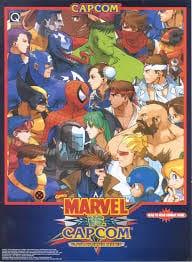
Marvel vs. Capcom: Clash of Super Heroes was developed and published by Capcom on CPS-2 arcade hardware, released in Japan and Europe in early 1998 as the third entry in Capcom’s Vs. series, following X-Men vs. Street Fighter and Marvel Super Heroes vs. Street Fighter. The game pairs fighters from Marvel Comics, including Spider-Man, Wolverine, Captain America, and Hulk, against Capcom’s own roster, such as Ryu, Mega Man, Morrigan, and Strider Hiryu, in fast, tag-team two-on-two battles. Players could call in their partner mid-combo for assist attacks or switch fighters on the fly, and landing a well-timed “Duo Team Attack” unleashed both characters’ special moves together for devastating combined damage. The game’s frantic pace, exaggerated animation, and constant on-screen chaos pushed the CPS-2 hardware to its limits and set it apart from the more grounded one-on-one fighters of the time. Its crossover premise, mixing two entirely different universes into one roster, proved hugely popular and helped establish the long-running Marvel vs. Capcom series as one of fighting gaming’s most enduring franchises.

Marvel vs. Capcom: Clash of Super Heroes

How to Play Marvel vs. Capcom Online

Press Start Game above to load the arcade emulator, insert a coin with Select and press Start. Pick two fighters for your team; you also receive a random Special Partner who can be called in for a single assist attack a limited number of times per match. Marvel vs. Capcom uses the six-button Capcom layout, so a gamepad is the most comfortable way to play, but the keyboard works too. Check or remap the keys in Control Settings inside the emulator menu.

Marvel vs. Capcom Controls

Input Action
Joystick Move, jump, crouch; hold back to block
Light / Medium / Heavy Punch Punch attacks of increasing strength
Light / Medium / Heavy Kick Kick attacks of increasing strength
Heavy Punch + Heavy Kick Tag out to your partner (Variable Attack)
Special move motion + two punches Hyper Combo, uses one level of the Hyper Combo gauge

Tips for Winning Team Battles

  • Tag before a character is in danger. The fighter waiting off screen slowly recovers the red part of their health bar.
  • Build the Hyper Combo gauge. It fills as you attack and take damage and can store several levels. Spend levels on Hyper Combos that end long chains.
  • Use the Variable Combination, where both teammates perform their Hyper Combos at once, to finish a weakened opponent.
  • Launch and chain. Most characters can knock an opponent into the air and follow with an aerial combo; practise this on the computer before playing friends.
  • Do not waste the Special Partner. Assist calls are limited, so save them to break pressure or extend a combo.

Roster

The Capcom side includes Ryu, Chun-Li, Zangief, Morrigan, Captain Commando, Mega Man, Strider Hiryu and Jin Saotome, while Marvel brings Captain America, Spider-Man, Wolverine, Hulk, Venom, Gambit and War Machine. Hidden versions of several fighters and the playable Roll can be unlocked with secret inputs on the character select screen. The final boss is the powerful Onslaught.

Related Games

Marvel vs. Capcom built on the tag system of Marvel Super Heroes vs. Street Fighter and X-Men vs. Street Fighter. For one-on-one Marvel fighting, try Marvel Super Heroes.
Similar Posts

  • Donkey Kong (Arcade)

    Introduction Donkey Kong is Nintendo’s original 1981 arcade platformer, the coin-operated cabinet that later inspired the NES home conversion, built around four distinct single-screen stages that each represent 25 meters of a construction site Mario, then called Jumpman, must climb to rescue Pauline from the giant ape Donkey Kong. The first stage has players navigating…

  • Darkstalkers: The Night Warriors

    Introduction Darkstalkers: The Night Warriors was developed and published by Capcom on CPS-2 arcade hardware, released in Japan in July 1994 as the first entry in the Darkstalkers fighting game series. Set apart from Capcom’s already-established Street Fighter series by its horror movie monster theme, the game’s roster includes the succubus Morrigan Aensland, the Frankenstein’s…

  • 1944: The Loop Master

    Introduction 1944: The Loop Master was developed by Eighting and published by Capcom, released in arcades in 2000 as a direct continuation of the 19XX series that began with 1942 back in 1984. Set in the closing stages of World War II, the game returns players to the vertical-scrolling shoot ’em up formula of its…

  • Art of Fighting 2

    Introduction Art of Fighting 2 was developed and published by SNK, released for the Neo Geo MVS arcade system in 1994 as the sequel to 1992’s Art of Fighting. The game continued the story of Ryo Sakazaki and Robert Garcia while expanding the roster with new fighters and refining the original’s technical systems, including a…

  • Street Fighter Alpha 2

    Introduction Street Fighter Alpha 2 arrived in arcades in 1996, and Capcom brought it to the Super Nintendo later that year. Set between the original Street Fighter and Street Fighter II, it expanded the roster with fighters such as Sakura, Dhalsim, Zangief, Gen and Rolento alongside returning favourites like Ryu, Ken, Chun-Li and Guy. Its…